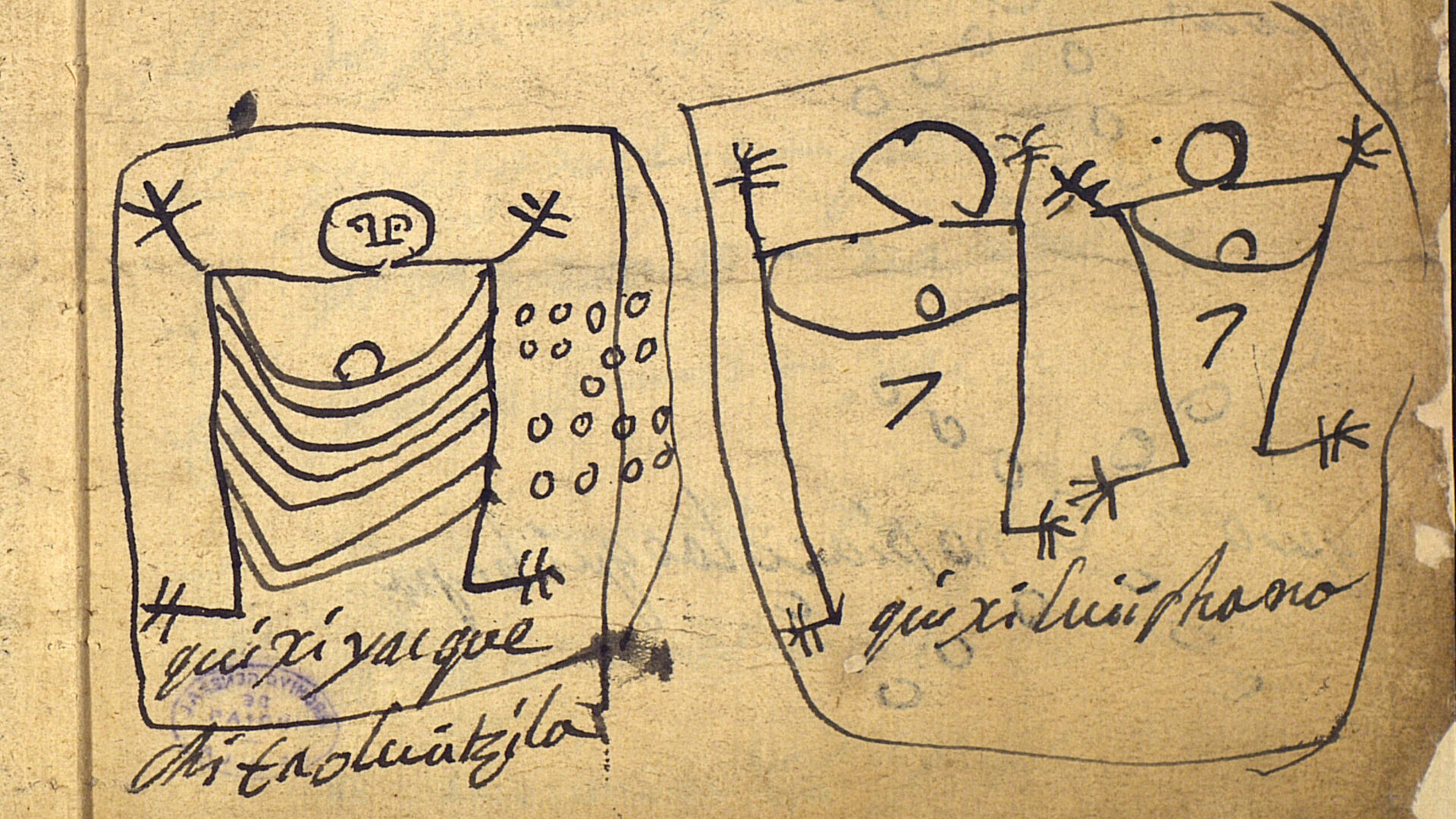
This site is named after biyee, the Northern Zapotec term for calendrical and divinatory manuals that circulated clandestinely in colonial Mexico in the seventeenth century. The site features a selection of colonial texts in various genres written by Northern Zapotec authors.
The manuals, along with cosmological drawings, multiple annotations, and four collections of ritual songs, were surrendered to Oaxaca Bishop fray Ángel Maldonado in 1704-05, and are now preserved at the Archivo General de Indias in Seville, Spain, in the legajo (archival unit) México 882.
These sources are complemented by transcriptions and analytical translations of a selection of colonial Northern Zapotec testaments, Christian texts in Colonial Northern Zapotec variants and Colonial Valley Zapotec, and ecclesiastic and civil trials of Northern Zapotec ritual specialists who were accused of idolatry or superstition. These documents were written between the sixteenth and the eighteenth centuries, and are preserved at a variety of archives.
You can explore the documents in this site by clicking on the name of a yeche (Zapotec community) in the map above. Each yeche is linked to documents that were produced in or are closely related to that community. You can search through and download these analyses of colonial Zapotec sources.
We request that you provide the citation indicated in each file, should you use these materials for educational, scholarly, or other non-commercial purposes. Please contact the site administrator at tavarez@vassar.edu if you have any questions. The citation for the entire site is:
Tavárez, David. 2023. Biyee: Northern Zapotec Texts, 16th-18th centuries. https://zapotectime.vassar.edu.
A thorough analysis and interpretation of these divinatory manuals, cosmological diagrams, ritual songs, Christian works, and testaments is found in Rethinking Zapotec Time: Cosmology, Ritual, and Resistance in Colonial Mexico, a book by David Tavárez published by the University of Texas Press in 2022.
Rethinking Zapotec Time has received the following awards:
2023 Best Subsequent Book, Native America and Indigenous Studies Association (NAISA)
2022 Marysa Navarro Best Book Prize, New England Council of Latin American Studies (NECLAS)
2023 Honorable Mention, Best Book in the Social Sciences, Latin American Studies Association (LASA), Mexico Section
_._
Homepage image: A depiction of 1-Jaguar (left), a deity associated with the creation of the 260-day count, and of two figures (right) associated with Huichana, a deity that presided over fertility, rivers, and fish. Each of these deities stand in their respective quixi, “wildlands, uncultivated landscapes.” Ministerio de Cultura y Deporte. Archivo General de Indias, AGI México 882, Manual 37, 708r.